The Sock Gap: Why Shelters Need Socks Most
By Stand4 Socks · Last updated 24 September 2026
Socks are frequently described by homelessness organisations as one of the most requested and least donated items at shelters.
There is a practical reason for this. People readily donate used coats, trousers and jumpers, while shelters usually need socks to arrive new. This creates a regular gap between the number of pairs available and the number people need.
Ahead of World Homeless Day on 10 October, here is why something as ordinary as a clean pair of socks matters.

1. What Is the Sock Gap?
The sock gap is the difference between the demand for clean socks among people experiencing homelessness and the supply reaching shelters and support organisations.
Delivering Good, a US nonprofit that distributes new products to people facing poverty and homelessness, describes socks as the most requested and least donated item in shelters across the United States.
Socks are the most requested and least donated item in shelters across the United States.
Delivering Good
Its One Million Pairs of Socks campaign has distributed more than 12 million new pairs since 2016. The scale of that campaign gives some indication of how persistent the need is.
The exact level of demand varies between communities. A local shelter may need different sizes, materials or quantities depending on the people it supports and the time of year. The wider pattern is consistent: new socks are needed regularly and donated less often than many other types of clothing.
2. Why Are Socks Donated Less Often?
Most clothing collections accept good-quality second-hand items. Socks are different.
People tend to wear their own socks until they are no longer suitable to pass on. Hygiene policies also mean that many organisations will only distribute socks that are new and unworn.
This makes socks easy to overlook during a wardrobe clear-out. A donor may have several coats or jumpers available, while a useful pair of socks usually needs to be bought specifically for donation.
Other factors contribute to the gap:
A successful sock collection therefore needs to ask for the item directly and confirm what the receiving organisation can accept.
3. Why Does a Clean Pair Matter?
People experiencing homelessness may spend long periods walking, standing or wearing the same footwear. Access to washing facilities and replacement clothing can also be limited.
A clean, dry pair of socks can help with:
A pair of socks will not solve homelessness. It can meet an immediate, practical need while housing organisations, outreach teams and local authorities work on the wider causes.
That distinction matters. Product donations should support frontline services rather than replace long-term action on housing, health and poverty.
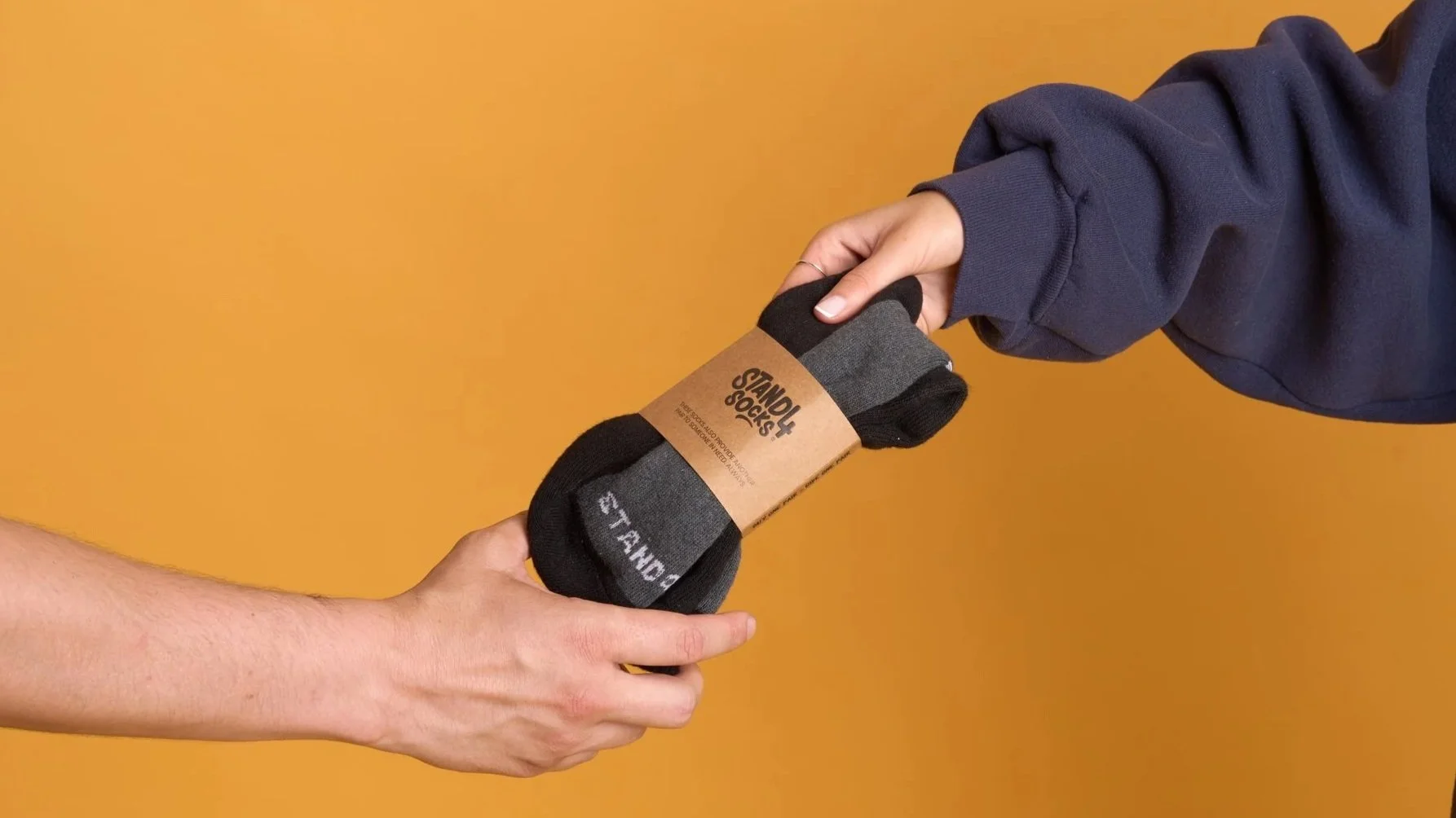
Stand4 Socks operates a Buy-One-Give-One model. For every pair ordered, a specially made pair is donated to someone experiencing homelessness.
The donated socks are designed for the needs identified through Stand4’s charity partners, rather than being unwanted stock or used products. More than 850,000 pairs have been donated through the model so far.
For organisations ordering custom socks, this means the merchandise also contributes to a practical local need. Employees, clients or event attendees receive the branded pair, while a matching quantity of purpose-made socks supports people experiencing homelessness.
Planning custom merchandise with a social-impact story? Send us your logo, estimated quantity and deadline. We can create a free initial mockup.
4. Why Purpose-Made Donation Socks Help
A donated product is most useful when it reflects what the receiving organisation actually needs.
Stand4 works with charity partners to understand the requirements of the people they support. Its donation socks are made with practical features suited to distribution among people experiencing homelessness.
This approach helps prevent a common problem in product donation: organisations receiving large volumes of items that are difficult to use, store or distribute.
Before organising any collection, speak to the intended shelter or charity. Ask:
The answers may change throughout the year.
5. How Can a Workplace Support the Need?
A workplace can use its team, suppliers and customer community to support a local organisation.
Run a focused collection
Ask specifically for new socks instead of including them in a broad clothing appeal. A focused request makes the need clearer and gives people a simple action to take.
Confirm the required sizes and deadline with the receiving organisation first.
Connect the collection to an existing event
A collection can form part of:
- World Homeless Day
- An employee volunteering day
- A company anniversary
- A winter support campaign
- A team meeting or company-wide event
- A customer or community activation
Keep the message centred on the organisation receiving the donations and the needs it has identified.
Choose merchandise with built-in impact
If your organisation is already ordering employee gifts, event merchandise or customer thank-you items, a Buy-One-Give-One product can connect the purchase to a practical donation.
With Stand4 custom socks, every pair ordered results in another pair being donated. The impact is linked directly to the size of the order and can be communicated clearly to recipients.
Support frontline organisations financially
Shelters and homelessness charities also need unrestricted funding. It helps them pay for accommodation, outreach, specialist staff, transport and other essential services.
A product collection can sit alongside fundraising or a direct company donation.
Build a longer-term relationship
One annual collection can help. A continuing relationship gives the organisation more reliable support.
Ask whether your team can contribute through regular donations, volunteering, fundraising, professional skills or awareness activity.
6. What Is World Homeless Day?
World Homeless Day is observed internationally on 10 October each year.
It was first marked in 2010 and is now recognised in communities around the world. Its purpose includes raising awareness of homelessness, supporting local action and encouraging progress towards preventing and ending homelessness.
There is no single annual theme. Organisations are encouraged to focus on the needs and work taking place in their own communities.
For businesses, the day can be used to:
- Highlight a local homelessness organisation
- Share a measurable support commitment
- Organise a collection requested by a charity partner
- Give employees time to volunteer
- Fundraise for frontline services
- Report progress on an existing partnership
- Review company policies connected to housing insecurity
- Invite a local homelessness expert to speak
The activity should be based on what the partner organisation finds useful.
7. How to Communicate a Sock Donation Responsibly
Social-impact campaigns need clear and respectful language.
- Which organisation is receiving the socks
- How the need was identified
- Whether the pairs are new and purpose-made
- How many pairs will be donated
- When the donation will take place
- How the activity supports wider work
Avoid language that reduces people to their circumstances or presents a product donation as a complete solution to homelessness.
Photography also needs care. Ask the partner organisation for guidance and obtain informed permission before photographing anyone receiving support. Images of the products, volunteers or organised donation can often communicate the activity without identifying service users.
Keep the focus on dignity, usefulness and accountability.
8. Questions to Ask a Merchandise Supplier
If you want an order to support a social purpose, ask the supplier:
- 1What exactly is donated?
- 2Is the donated product new and purpose-made?
- 3How is the quantity calculated?
- 4Which organisations receive the donation?
- 5How are recipients’ needs identified?
- 6Is the impact included in the order or charged separately?
- 7Can the supplier provide evidence or an impact summary?
- 8Can the story be included on the product packaging?
- 9Are there any claims or wording the charity partner prefers?
- 10Can the donation support a community near the buyer?
Clear answers will help your organisation communicate the impact accurately.
Explore how custom socks can help your organisation demonstrate its values.
9. Planning a Workplace Sock Collection
Before announcing a collection, confirm:
Once the campaign ends, tell participants how many pairs were collected and where they went. If the receiving organisation is comfortable sharing an update, explain how the donation will be used.
Frequently Asked Questions
Are socks really the most requested item at homeless shelters?
Delivering Good describes socks as the most requested and least donated item in shelters throughout the United States. Needs vary between organisations and locations, so contact your chosen shelter before organising a collection.
Can I donate used socks?
Many organisations only accept new, unworn socks for hygiene reasons. Check the receiving organisation’s policy before donating.
What types of socks should I donate?
The answer depends on the shelter and season. New, practical adult socks are commonly requested, but some organisations may need children’s sizes, thermal pairs or particular materials. Ask before buying.
How does Stand4 Socks’ Buy-One-Give-One model work?
For every pair ordered, Stand4 Socks donates a specially made pair to someone experiencing homelessness through its charity partners. The donated pairs are designed for practical use.
Can a company organise its own sock collection?
Yes. Contact a local homelessness organisation first and build the collection around its current needs. Confirm sizes, materials, quantities, packaging and delivery arrangements before promoting the campaign.
When is World Homeless Day?
World Homeless Day is observed internationally on 10 October every year. It provides an opportunity to raise awareness, support local organisations and review progress towards preventing and ending homelessness.
Help Close the Sock Gap
A clean pair of socks is a small item with an immediate practical use. Your organisation can help by responding to the needs of a local shelter, supporting frontline services and choosing company merchandise that includes a clear social impact. Tell us what you are planning, how many pairs you need and when they must arrive. We will help you create custom socks for your organisation and provide a free initial mockup.
Get your free custom sock mockup