
Why Wearable Merchandise Outperforms Traditional Corporate Gifts
Corporate gifting has evolved significantly over the last few years, but one of the biggest shifts is happening in how businesses think about merchandise. For a long time, the default approach was simple: create something branded, distribute it widely, and hope it creates visibility. However, in practice, most traditional corporate gifts fail to deliver lasting impact because they are not designed with real-world usage in mind.
Items like novelty desk accessories, generic giveaways, or low-quality promotional products often achieve short-term attention but rarely create long-term engagement. They are received, briefly noticed, and then quickly forgotten. In many cases, they never make it into daily use at all. This creates a fundamental issue for businesses: if a product is not used, it cannot reinforce the brand behind it.
Why Traditional Merchandise Falls Short
Most corporate merchandise is still designed with the assumption that visibility alone is enough. The thinking goes that as long as a logo is present, the brand is being reinforced. In reality, visibility without usage has very limited impact.
Many traditional items suffer from the same issue: they are not inherently useful. If a product does not serve a clear purpose, it is unlikely to be used consistently. And if it is not used, its ability to influence perception or behaviour is effectively zero.
There is also a growing expectation from recipients that branded products should feel high quality and intentional. As standards rise, poorly designed merchandise can actually have the opposite effect, subtly reducing brand perception rather than enhancing it.

Wearable Merchandise Creates Continuous Brand Exposure
Wearable merchandise solves many of the challenges associated with traditional gifting because it naturally integrates into everyday life. Unlike items that remain stationary, wearable products move with the person, which extends brand exposure far beyond a single environment.
This is especially powerful because it creates repeated, organic impressions. Instead of relying on a single moment of engagement, wearable merchandise continues to reinforce the brand over time through consistent use.
Why Socks Have Become a High-Impact Category
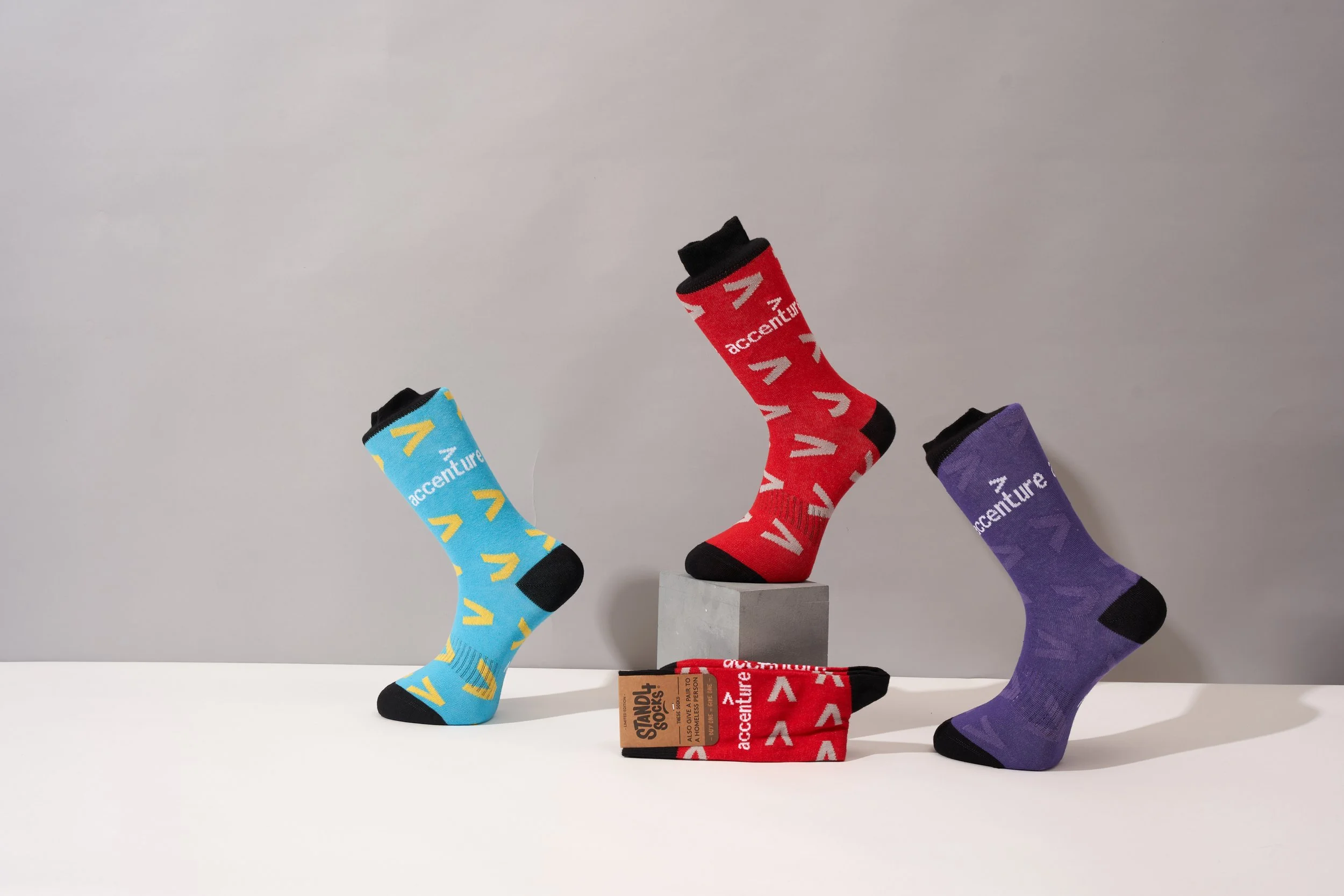
Within wearable merchandise, socks have emerged as one of the most effective and practical formats. They combine everyday usability with broad appeal, making them suitable for a wide range of audiences and industries.
Unlike other wearable items, socks avoid many of the barriers associated with sizing, styling, or personal preference. This makes them easy to distribute at scale while still maintaining a sense of personal usefulness.
They are also inherently functional, which means they are far more likely to be used regularly compared to many other promotional items. This regular use creates consistent brand reinforcement without requiring any additional effort from the business.

Final Thoughts
Wearable merchandise represents a clear shift in how businesses approach corporate gifting. Rather than focusing on short-term visibility, companies are increasingly prioritising long-term engagement, practicality, and real-world usage.
Traditional corporate gifts often fail because they exist in isolation from everyday life. Wearable products, by contrast, become part of it. This simple difference fundamentally changes how brand exposure is created and sustained over time.
As businesses continue to refine their approach to employee engagement, client relationships, and brand marketing, wearable merchandise is becoming less of a novelty and more of a strategic tool.
